Friday, March 28, 2008

Cheap Scapes: Collecting Your Own Rocks

Who ever though they'd be paying good money for a rock when they started an aquarium? Yet many of us do. After discussing ways to save money while creating a beautiful aquarium in the last post, I touched upon collecting rocks yourself to use in your aquarium to save money. I've decided to continue the budget aquascaping theme with a post on collecting your own rocks to use in your aquariums. If you're lucky enough to live in or near an area that has appropriate rocks, this can be a great money saver and add a unique flavor to your aquascape. Sure, you'll get some strange glances as you lug a bag of rocks back home, but it's worth it!

It can be difficult to find rocks locally that "fit" into an aquarium. Some will just look out of place underwater. The best rocks are those found in or near water. Rivers, streams, and lakes are the best source. These rocks often have more rounded edges and will look more natural in the aquarium. Since they also are often worn smooth, you will have less of a problem with algae or detritus collecting on the rock. Finally, since they have been under water before, they are most likely (although not always) safe to put in your aquarium.

This brings up several important things to remember when putting rocks in your aquarium.
First and probably most important is the fact that some rocks just aren't suited for aquariums based on their composition. Certain chemicals contained in the rocks can leach into the water and play havoc with your water parameters. Some, like calcium carbonate or magnesium carbonate, will make your water hardness go through the roof as the elements dissolve into the water. Marble, limestone, coral, dolomite, or anything similar will do just that. While it's possible to live with rocks that impact your water parameters (Amano scapes often use such stones) in the long run, it just isn't worth it. Rocks with obvious metallic seams in them should also be avoided as they can also leach harmful substances into the water. A decent (although somewhat dangerous) method of testing whether or not a rock will dissolve into your aquarium is to put a few drops of acid onto it (strong vinegar or muriatic acid; be careful!) and see if it foams or fizzes after a few minutes. If it does, it likely contains an element that will affect your water parameters.

Second, rocks come from an outdoor environment. They can carry all sorts of dirt and substances on them that may be harmful to your aquarium's ecosystem. What I do is wash them thoroughly under running water with a mild soap to remove any loose dirt and oils. Then, I put them in a pot of water and boil them for a while. This kills any living things on the rock that I may not want in the aquarium. After the rocks have cooled they should be ready to be placed into your aquarium.


Using this knowledge, and a basic understanding of geology, it's possible to find unique and interesting rocks locally for your aquarium. Best of all, they're free!

Monday, March 10, 2008

Cheap Scapes: Tips for Budget Aquascaping

Although we look at beautiful sweeping aquascapes in magazines and books and websites in awe, not all of us can afford such an investment. A fully equipped, top of the line aquascape can easily cost in the thousands of dollars, about as much as a fancy reef aquarium. Here are some tips to save cash and have a great looking aquarium at the same time.

  1. Buy Used - Getting a brand new tank or brand new equipment may be appealing, but it often costs a fortune. Most of the money in an aquarium is devoted to lighting, filtration, and the actual tank and stand itself. Finding these used can save you a fortune. Sure, you'll have to put up with some scratches in the tank glass or maybe a somewhat noisy filter, but they'll still function just the same. Just make sure everything is in working order before you pay. The best part of this though, is that even if it doesn't work, you end up spending 1/10th what you'd spend on it new, so you can either throw it out or fix it up. eBay, Craigslist, and the For Sale section of fish forums are the best places to look.
  2. Smaller is Cheaper - We all know deep down we want a 120+ gallon tank so we can have a sweeping aquascape with hundreds of fish and plant species. Heck, who wouldn't want to follow in Amano's footsteps and create a whole room sized aquarium? The problem is, as the size expands, so does the price. Exponentially, in fact. To support that bigger tank you need a bigger stand (or even a bigger room/apartment/house!), more light, bigger filters, more power to run all the equipment, more substrate, and more money spent on stocking it with fish and plants. Compromise on size. In fact, look at a smaller tank as a challenge. Aquascaping a nano is much, much harder than a large tank. As a benefit, the maintenance won't take a whole day either!
  3. Do It Yourself - Love that fancy glass CO2 diffuser? Oops, it costs more than you paid for your second-hand tank! Not to worry, there are often many simple, quick, and best of all FREE (or really really cheap) ways to improve your aquarium. DIY CO2 can save you hundreds of dollars and DIY lighting is effective as well. You can even make a DIY filter if you've got the right tools and don't mind troubleshooting a few leaks and issues (trust me, I've done it). Although some of these DIY adventures will often result in just a temporary solution (like my DIY filter that was replaced by a second hand Eheim after a month) they can be a lot of fun and with persistence can save you money. Check out the DIY section for some example projects. DIY can also apply to the hardscape in your tank. Why buy rocks and wood when you can find it outside for free? Granted, not everyone can find appropriate rocks and wood locally and you have to be careful in what types of wood and rock you put in your tank and what it might introduce. With proper procedures though, you can get an awesome, natural hardscape for free!
  4. Be Patient - Sure you can rush out to the fish store and buy 20 tetras and splurge on 4 or 5 of each exotic high-light plant and your tank will look pretty good...for a few days. However, very soon you might be faced with a mass die off as ammonia levels spike and plants wither and rot. It's the ultimate tank meltdown as you watch all that money you spent on plants and fish melt into goo. Be patient and hold off on fully stocking your tank and don't get difficult plants right off the bat. Add new fish gradually and fill the tank up with cheap, fast growing, hardy plants to fend off algae and absorb the ammonia. These cheap plants can often be found for free, which brings me to my last point.
  5. Leverage the Community - There's a huge community of fish keepers and aquascapers out there. You can find them in aquarium clubs or online in fish forums. Most, if not all, have members who are willing to give away excess plants and fish for FREE. These are usually easy to grow starter plants or fish that are hardy and multiply quickly: perfect for a start up tank. Then, once you get established, you can return the favor and give away your excess and move on to the harder varieties. Once you have an excess of these, you can even sell them back to the community, generating some revenue to offset the cost of the hobby. Try Aquabid for cheap plants and fish; you can sell your own plants and fish there too. You probably won't break even, but it'll help mitigate the ongoing maintenance costs associated with an aquarium.

Hopefully these tips can help you achieve a beautiful aquascape without spending thousands of dollars. Although it can be an expensive hobby, you can get just as much enjoyment out if it for a fraction of the price.

Monday, February 11, 2008

Beautiful Biotope Aquariums

Amano style aquariums are beautiful to look at, but they are far different from the actual environments on which they are based. Although they are often referred to as nature aquariums, many incorporate plants and animals that would never be present together in the wild. Recreating a particular environment with native plants and animals, also called a biotope, can be as beautiful and challenging as creating a tranquil Amano aquascape. Through careful research and planning, it's possible to have an accurate piece of nature in your home. According to the AGA, a biotope aquarium

"models the physical conditions in a biotope and is populated by plants and animals that are found together in that biotope. In an accurate biotope aquarium, the water temperature, water movement, water chemistry, color and turbidity mimic the natural habitat. Stones, wood and debris, if present in the biotope, are also present in the biotope aquarium. The substrate in the biotope aquarium is similar to the natural substrate."

Despite the restrictions of a biotope aquarium, many hobbyists have been able to cr
eate spectacular masterpieces that rival the best Amano style aquascapes. After all, Amano style aquariums are inspired by nature, while biotope aquariums aim to mirror nature. There are also other reasons to set up a biotope aquarium. The natural habitats create different behavior in fish than seen in a community aquarium and make it much easier to get fish to spawn. Finally, the challenge of setting up a successful and true-to-nature biotope aquarium is certainly something to brag about. Here are some examples from the biotope category of the 2007 AGA Contest to get your creative juices flowing:


For more information on biotope aquariums and examples of freshwater biotopes, try Badman's biotope page.

Wednesday, January 23, 2008

Planted Amano Aquarium: From Start to Finish

I stumbled upon this really useful article today that details the development of one of Takashi Amano's planted aquariums from start to finish with pictures. It's called "A Path to the Finished Aquarium." Although it doesn't start from the very beginning (including the setup of the tank), it shows how to trim stem plants to encourage bushy growth and how an aquascape grows and matures over the course of two months. Also helpful, it includes all information about the aquarium, including lighting type, strength, and duration and fertilization strategies. Here are the first few entries.

May
31st, 2005 (7th day)

A week from planting. Although half of the tank water was changed daily, the water still looked somewhat cloudy. The growth of stem plants was still sparse.


June
8th, 2005 (15th day)

15 days has passed since planting. The water has become clear. Glossostigma and Echinodorus tenellus have developed runners and Willow Moss on driftwood is growing steadily.


June
15th, 2005 (22nd day)

The first trimming on the 22nd day from planting. The stem plants planted at the same time to the same height were beginning to show a difference in their growth depending on their types. Trimming became necessary to keep their growth in balance.


Check out the rest of the entries and the detailed aquarium specifications in the article.

Monday, January 21, 2008

Nano Aquarium Update

I figured I'd give a quick update on the nano aquarium I started a few months ago. I've since decided to add some fish, and along with them a nano filter. I went with one from RedSea and it's perfect for a nano sized aquarium. For fish, I went with Boraras maculatus, a type of microrasbora, also known as the dwarf rasbora. I have one male and two females. These fish are tiny and three fit comfortably in this one gallon aquarium. They like soft, acidic water, so I've added some peat to the filter (which has plenty of room for adding your own media) which is why the water is tinged brown. The moss has grown the fastest of any of the plants in there, and I've actually taken out quite a bit to keep it looking somewhat neat. Everything else is growing very slowly in the low light.

A word of warning about these fish though, they are so small (less than a centimeter in length) that I nearly lost one within minutes of putting it into the tank. I nearly had a heart attack as I saw it struggling inside the filter intake tube trying not to get sucked into the impeller. I ripped the filter's plug from the wall as fast as I could and luckily the little guy swam out unharmed. After that, I cut up a filter media bag and wrapped it around the strainer filter intake to prevent further accidents.


Wednesday, January 02, 2008

Underwater Aquarium Waterfall Video

For everyone looking for a video of the underwater waterfall concept in motion, here it is! It comes from Derk of Aquatic Quotient who said it took him 3 failed tries to get it to work, but work it does. Congrats Derk!

Friday, December 14, 2007

Understanding Full Spectrum Aquarium Lighting

Picking the right lighting for your planted aquarium can be intimidating and confusing. There are so many options to choose from, and so many ways to measure these options. The first step to understanding full spectrum aquarium lighting is to understand what type light your plants need, and what the measurements mean.

Color temperature, measured in Kelvins, is often the easiest measure to find, after wattage. It is a measure of the overall color of the light as it appears to the human eye. Lower color temperatures appear reddish while higher temperatures appear bluish with white in the middle of the range. Often, a temperature between 5000K and 10,000K is recommended for a planted aquarium. However, two bulbs with the same color temperature may in fact be emitting very different light, some more useful to plants than others. This has to do with the different wavelengths of light, and explains why relying on color temperature alone can be misleading.

Visible light is made up of many different wavelengths, mixed together. It's the absorption or reflection of particular wavelengths that produce colors. Plants require certain wavelengths of light to carry out photosynthesis using chlorophyll. The light that chlorophyll absorbs is used to power photosynthesis. By examining the wavelengths of light absorbed by chlorophyll, we can begin to understand the needs of our aquatic plants.

As shown above, plants need the majority of the light to be around 400-450nm and 650-675nm (or blue and red light). The blue light is used for leaf growth, and promotes bushy, compact growth, while red light is mainly used for flowering and strong stems. They reflect most green light, thus explaining why leaves are green.

Armed with this information, we know that any aquarium light will need to produce large amounts of blue and red light. Most bulb manufacturers include the spectral output graph of their products on or in the packaging. Examine this output graph and try to find a bulb that matches up with the spectral absorption graph for chlorophyll. The closer the match, the better the bulb will be for your plants. For example, the following graph is for a GE 9325K bulb.

The bulb matches up fairly well, although the spike at 600nm is not really red enough (650-675nm) for a plant to fully benefit. The blue light spike is however beneficial, and the spike in greenish-yellow light will make the bulb look bright to the human eye.

Although you may not notice a major difference between bulbs, a mix between a color temperature that you like and a spectral output that your plants like will help create healthier plants and a healthier aquarium.


For more in-depth information on the science of full spectrum aquarium lighting, check out this discussion of aquarium lighting science and photosynthesis, or this aquarium light bulb comparison study. For more information on lighting metrics, check out this page on Kelvin, nanometers, PAR, and CRI.

Saturday, October 27, 2007

Creating a Waterfall Illusion Underwater

I was curious as to how the tank above, which took World Ranking 7 in the ADA aquascaping contest this year, created the waterfall illusion. I had seen similar effects created by rising bubbles, but this seems to end before reaching the surface, meaning it is created using a different method (or there was a good deal of Photoshopping involved). However, an anonymous comment tipped me off to a website that explains exactly how it was created, and it is quite creative. To start off, the illusion is created with falling sand, not rising bubbles. However, bubbles still play an important role. See the diagram below:

This is a cross section of the "waterfall." A tube and airstone blows bubbles up through a space behind the wall, and as a result, pulls water and tiny grains of sand (blue dots) from a sloped reservoir (sloped so that gravity pulls the sand down and into the bubble stream) up the narrow space. Once the grains reach a second opening, they forced out the second opening with the water current and fall back down the front of the wall back into the reservoir. Here's a picture of what this looks like before any plants are added:

As you can see, very fine sand must be used for this to work. Additionally, where the sand falls is affected greatly by other currents in the tank, and it will inevitably fall outside of the reservoir. This means this effect is not the most practical for everyday use, as using it with a filter would probably blow the falling sand everywhere else in your tank. I'm sure much tweaking and adjusting is necessary to find the best type of sand suited for this application, and what size space behind the wall works best. How the sand is ejected from the top of the bubble column is also probably a problem area that requires a lot of attention and adjustment. It's hard to tell from the diagram, but the bubble column space most likely extends above the water line. This forces the water pulled up by the bubbles out the sand-ejection opening. Otherwise, the sand would continue to follow the current of bubbles and water up and out the top of the column (and you'd have a messy volcano effect instead of a waterfall!). The final effect, if done correctly, looks absolutely stunning in pictures.

Monday, October 15, 2007

ADA 2007 Aquascaping Contest: Top 10 Rankings

Finally got some time to throw these together with a little commentary; these are the top 10 aquascapes from the 2007 Aqua Design Amano Aquascaping Contest. The contest, held yearly and open to anyone, is the most significant award in the hobby and garners international recognition. The entries are judged by Takashi Amano himself and other renowned judges. There are some fairly original and interesting ideas in some of these and they are great inspiration!

World Ranking 1
This is a classic Nature Aquarium style tank and the contrast between the heavily planted left side and the open right side create a tranquil border scene complete with sandy foreground. The use of rock and driftwood help to add structure to the aquascape.

World Ranking 2
A lovely hillside scene with rocky outcroppings and schools of tiny colorful fish create an idyllic scene in this iwagumi inspired layout.

World Ranking 3
The carefully placed petrified wood in the foreground of this beautiful aquascape combined with the lush, overflowing green vegetation create the atmosphere of overgrown ruins deep in a jungle. The nearly terraced midground creates a beautiful "staircase" effect up to the dip in the plants where a school of fish hover like a flock of tropical birds. This is my personal favorite of the top 10.

World Ranking 4
Diagonal layers of ferns on driftwood create a stunning effect coupled with the contrast of the orange-tipped plant on the right side of the tank. The grassy, pastoral foreground complete with a school of fish completes the scene.

World Ranking 5
This aquascape looks like a lush mountain, with the two background groups of plants overlapping, creating a valley-like feeling. I love the contrast in colors and textures in this one.

World Ranking 6
An "island" aquascape, the driftwood adds a lot of interest and I especially like the hint of red peeking over the midground plants. The white sand foreground must be a pain to keep clean though!

World Ranking 7
This is a particularly interesting aquascape. I'm not quite sure how the designer created the illusion of a waterfall, but it could have been done with sand or air bubbles. Either way, the visual interest of this aquascape is amazing. It's such a beautiful tropical scene, with lush plants and mosses surrounding a clearing filled with grasses. The slope of the entire aquascape also adds such depth to the scene that it makes it seem much bigger than it actually is.

World Ranking 8
The most striking feature of this aquascape is the vertical rock formations. They are perfectly placed and dotted with all sorts of plants, creating an overgrown, natural look.

World Ranking 9
The black background of this aquascape helps to bring out the brilliant green colors of the plants, and the two red plants, on either side of the "valley" provide contrast.

World Ranking 10
Filipe Oliveira's entry, this is such a unique and wonderful aquascape. The moss "tree" and the pastoral setting beneath are fundamentally relaxing and pleasing to look at. It's also the only entry in the top 10 rankings from outside Asia.


Tuesday, October 09, 2007

Top 27 2007 ADA Contest Aquariums

Here they are finally! The top 27 aquariums from the 2007 ADA Aquascaping contest are listed along with comments from the judges over at Practical Fishkeeping's blog. The picture above is the winner of the contest, but some of the others are extremely interesting as well. Go have a look!

Sunday, October 07, 2007

Internet Explorer Viewing Difficulties

The issues have been fixed, sorry for any inconvenience it may have caused!

I've just noticed that in Internet Explorer, the sidebar seems to be pushed way down the page for some reason. It looks fine in Firefox, however. I've done a bit of research and it turns out IE is just really fussy and it could be any little error in the code. So I have to sort through the entire code and see if something is tripping up IE. I apologize to all those who use Internet Explorer, I'll try to have it fixed as soon as possible, but bear with me, it's going to take a long time to figure this out! In the meantime, you may want to look at getting Firefox instead...

Aquascape Analysis #8: J. Reece's "Iwagumi Rock Garden"


This Aquascape Analysis is for Jordan Reece's beautiful "Iwagumi Rock Garden," which was also the tank of the month at Aquatic Plant Central. The tank is an ADA 90P and it's a perfect example of Japanese style (Amano inspired) aquascaping.

First, the profile is a pleasing "V" shape with two uneven peaks on either side. This creates a natural valley in the middle, carpeted nicely with Hemianthus callitrichoides. The two rocks help create the height, aided by some taller stem plants. They also act to separate the aquascape into three distinct areas: the left, the middle, and the right. This is aesthetically pleasing to the viewer.

The focal point is clearly the rock on the right side of the aquarium. The bight green plants around it help to create a draw for the viewer's eyes, contrasting with the darkness of the rock itself. There is a secondary focal point on the left side of the tank around the other rock, which draws the viewer's eyes because it juts up into the background.

Both rocks form the basis for the flow present in the aquascape. Since they are mostly vertical, the viewer's gaze naturally flows down the rock from the focal point and towards the opposite focal point, crossing the middle of the tank.

The foreground, which wraps around the front of the aquarium, is separated from the background by the Blyxa japonica. The contrast in textures between these two plants makes the area where they meet and overlap very interesting and pleasing. The taller plants behind the rocks help to create a deeper sense of depth to the aquascape, enhancing visual interest.

Overall, this aquascape could very well have come straight out of the ADA gallery. Congratulations to Jordan for creating such a beautiful and mesmerizing aquascape!

Sunday, September 23, 2007

ADA Awards Ceremony and Party 2007


On September 16th, the Tokyo was home to the equivalent of the Oscars for the aquascaping community. The awards for the International Aquatic Plants Layout Contest 2007 winners were awarded and slides of the winning aquascapes were displayed. Although there aren't any clear pictures of the aquascapes yet, there are photos of the slide show and event over at Creative Aquascape Union. Check them out and I'll post the winning aquascapes when better photos pop up!

Friday, September 07, 2007

Hagen AquaClear Filters

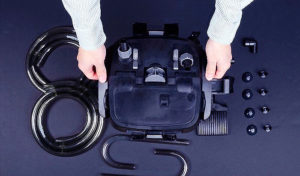
Some products are just so well designed and versatile that they become the work-horse of their market. The Hagen AquaClear filters are just that. They're cheap, they're dependable, convenient, and they get the job done. I've had my AquaClear for over 10 years now and it still performs as if it were brand new.

The AquaClear line consists of hang-on-back (HOB) filters in diffe
rent sizes that simply hang over the edge of the aquarium, eliminating the need for hoses and space beneath the aquarium to house an external filter. They are a perfect solution for beginners and those short on space. The filters are also extremely economical, ranging from just $22 for a Mini which is rated up to 20 gallons to $65 for a monster 500 which can handle up to 110 gallons all by itself.

The system works by pulling water up through an intake tube via an impeller and pushing it through the filter media and back into the tank via an overflow lip. The media is where the AquaClear filters really shine. Unlike other HOB filters that use cartridges, AquaClear media is held in an easy to remove insert, but each set of media (biological, chemical, mechanical) is it's own individual unit, wrapped up in a mesh bag and stacked one on top of the other. This makes it very easy to clean and prevents shock to the aquarium since you can replace the media one at a time, allowing the bacterial colonies to propogate from the old media to the new. It also spreads out the media over a greater area, allowing longer contact times and improving efficiency. Using your own media is possible, though not as convenient as in a canister filter. The set-up also allows for easy restarts, since the distance the impeller has to pull the water is minimal. All is needed is to fill the filter with water and the impeller will do the rest. The filter also allows the flow to be adjusted by simply shifting the intake tube to the side of the impeller. This is handy during feeding times when you don't want the filter's flow to create a blizzard of food flakes. The lack of tubing and the ever-annoying suction cups (ever done battle with a suction cup inside your tank that just doesn't want to let go?) also makes it very easy to move this filter from one tank to another, making it an excellent choice for a quarantine tank filter or a seeding filter to jumpstart the bacterial colonies in a new tank.

The quality of the plastic used in the filters is a little questionable, but unle
ss you routinely abuse your filter equipment with heavy objects or like to leave it out on the floor to step on, it's not a big deal. The only other qualm users might have is the waterfall style outflow. This can get quite noisy depending on your water level (unless you enjoy the noise of splashing water) and for those of you with CO2 injection of some sort, the water disturbance will cause a lot of CO2 to escape.

If you're looking for a cheap, basic filter that is dependable and convenient, AquaClear filters are definitely a best buy, earning five out of five fish.

Rating:


Tuesday, August 28, 2007

A Closer Look: Nano Aquarium

After receiving many questions on my new nano aquarium I've decided to go into a bit more detail:

  • Lighting - It's a clamp light from Ikea called DINGE with an 8 watt compact fluorescent flood bulb of normal "soft white" color temperature. It's kept on for about 8 hours a day and is clamped onto the side of my desk bookshelf above the tank.
  • Temperature - There is no heater in the tank, but my computer sits right beneath it under the desk, so it gets a constant stream of warm air flowing past it, keeping it slightly warmer than room temperature.
  • Water Changes - I change about 40% of the water every week using a small plastic cup.
  • Fertilizers - I use no fertilizers, since the light is not very intense, the plants are not very demanding plants, and the small size of the tank would make overdosing fertilizers far too easy
In the future I'm planning on moving some cherry shrimp to the tank. The Malaysian trumpet snails that are currently in the tank are thriving and have already had babies. There are also a lot of little cyclops copepods darting around the tank, so I know the water is very clean and balanced. The gravel is starting to show a slight green tinge from algae, so I may move the cherry shrimp in sooner rather than later, as they help to control algae. I'll keep you guys posted on the progress!

Sunday, August 19, 2007

New Nano Aquarium

I've been very busy over the past month, hence the lack of posts, but I did find some spare time to create a new aquascape for my nano aquarium.


The glass vase is about 1/2 a gallon (about 1.8 liters) so it's quite small. The light is a simple 8 watt compact fluorescent flood light I bought at Ikea (it's not really the right color temperature, but it gets the job done). There's no filtration, since doing water changes is so easy and there's no livestock except a few Malaysian trumpet snails.


It looks rather barren now, but it should slowly but surely fill in. The plant in the back is a narrow leaf Java Fern, the front left is a dwarf Sag and the front right is Stargrass. There's also some Christmas moss tied to the rock and a little leaf of hydrocotyle on the far right. I think once it gets established I'm going to move in a few cherry shrimp to add some color. The total cost of this nano aquarium was about $20 for me, but would be about $50 for all materials:

  • $15 for the bulb and light
  • $20-30 for the vase (I had it on hand)
  • $5 for the substrate
  • $5 for plants (Came from another of my tanks)
  • $5 for wood and rock (Already had this on hand)

Friday, July 27, 2007

Cooling an Aquarium

As it is the height of summer here in the northern hemisphere and the temperatures in my tanks can get as high as 85F (30C) I figured a post on cooling an aquarium would be relevant and useful. If you don't have air conditioning in the room where your aquarium is located or in your home at all, these tips can help to reduce the stress on your aquarium.

Just like the sun on a hot summer day, the lighting in your aquarium is probably responsible for most of the heat raising the temperature in your aquarium. With planted aquariums, the lighting often gets very hot and if the temperature of the room where the aquarium is is high as well, this can rapidly warm the water. Therefore, one of the ways to cool your aquarium is to cool your lights. Cooling the aquarium lights also helps to extend the lives of the bulbs, so if your lighting doesn't come with any sort of ventilation fans, consider adding some. They can be purchased at almost any aquarium supply shop or online.

Another way to cool your lights is to raise them up off any sort of canopy you may have. This will improve air flow around them and in turn reduce their temperatures. Also, removing an aquarium lid or canopy can also reduce the temperature in the aquarium through evaporation. As the water evaporates, it cools the remaining water and with the top of the aquarium open, evaporation occurs much more rapidly. The downside to this is you will have to top up your aquarium much more frequently to make up for the increase in evaporation.

For a simple and cheap way to cool your lights and your aquarium at the same time, try placing a regular household fan next to your aquarium at water level so it is blowing across the top of the water. Or you can get specially designed aquarium cooling fans like the ones above. By moving air across the surface, you are increasing the rate of evaporation and therefore cooling the remaining water. The moving air will also cool the lights. Again, the downside to this approach is watching the water level and topping it off to make up for all that water being lost.

If you have money to spend, the best option for cooling an aquarium is a chiller. These are not cheap and are usually at least $500 but it is basically an air conditioner for your aquarium. Some use electricity and a semiconductor to cool the water and others move the water past coolant. I would only really recommend these if you have money to burn or if you live in an area where the temperature of your tank is consistently pushing 85-90F (30-32C) and you are trying to keep heat sensitive specimens such as shrimp.

A final, and marginally effective method is to do partial water changes with cool water. A word of warning here: do not use very cold water and do not change a lot of the water at once. Large temperature swings will be very stressful on your fish and could end up in illness or death. Instead, change small amounts with slightly cooler water often. Another idea I've seen discussed is to use a small plastic container floated on the surface full of ice. As long as you have good circulation in your aquarium and as long as it isn't too much ice, this should work alright as well. However neither method will bring the temperature down very low without a lot of effort.

Good luck!

Wednesday, July 25, 2007

Iwagumi Rock Placement Animations

Sorry about the broken links, the website (www.aquasaigon.org) seems to have disappeared. I'm trying to find the images elsewhere but not having much luck. Hopefully the website will be back up soon.

Sorry it's been a while since the last post, it's been a combination of a hectic personal life and running out of post ideas for the most part. I'm still looking for another worthy tank to analyze for an Aquascape Analysis so that should be up sometime before the end of the month.


For now, take a look at these animated images found on http://www.aquasaigon.org. They detail the different layers of rock used in an iwagumi aquascape:


You'll also notice that the first stone placed is placed according to the Golden Rule of Aquascaping.

Friday, July 06, 2007

Malaysian Trumpet Snail Time Lapse Video

This video is a little bit creepy but fascinating to watch as it shows a swarm of Malaysian Trumpet Snails consuming a patch of algae on the aquarium glass. It also demonstrates just how useful snails can be!

Sunday, July 01, 2007

Growing Beautiful Aquatic Mosses

Aquatic mosses can be some of the most beautiful aquatic plants if grown correctly and given the right environment. Wispy fronds of all shapes and configurations can add texture and detail to any aquascape. However, one unique aspect of most aquatic mosses is that their appearance is highly dependent on their environment. This can make the difference between a lush, full wall of Christmas moss and a stringy tangled mess. Here are some tips to get the most out of your aquatic moss, whether it be simple Java Moss or Peacock Moss:

-
Mosses love light. Although they will survive in minimal light (especially the ever hardy Java Moss) they will grow scraggly and stringy and grow very slowly. The more light you give your moss, the faster and fuller it will grow.

-
Mosses grow best attached to something. This is their epiphytic nature. They can attach to almost anything using strong anchor fibers, but the best options are rocks or driftwood. Simply tie the moss down onto an object and within a week or two it will be safe to remove the string. If you let your moss drift around, it will grow stringy and be much less attractive.

- Mosses grow much better with CO2. Although not needed, growth is dramatically affected by CO2. When I first added CO2, my Christmas moss took off and grew very rapidly. Combined with higher light and being attached to something, it also makes the moss more dense and healthy looking.

- Avoid moss eating fish and bugs. Siamese algae eaters top out the list here as the worst offenders, but there are also reports of small bug-like animals that can also devour whole stands of moss in days. If you see stripped fronds or notice your moss looking more stringy than usual and you have an offender in your tank, you are best off moving them or trying to feed them enough so they don't take to snacking on your moss.

-
Periodically clean out your moss. Moss works as an excellent filter, trapping all sorts of debris. The trouble is, this also encourages nasty types of algae to grow, including Blue Green Algae. When you change your water, run your fingers through the moss and shake out any loose debris, making sure to remove as much of it as possible from the tank.

-
Avoid algae at all costs. It is next to impossible to clean any type of algae out of moss. Often, if your moss becomes infested with algae, you'll have to rip it out the affected areas completely. The fronds are just too small and delicate. Instead, maintain adequate CO2 levels and fertilize regularly to fend off algae.

- Mosses love being trimmed. As much as a pain in the butt it can be to try to trim moss and clean up all the cuttings, it will grow back thicker and fuller. There really is no strategy, just trim it back with scissors and try desperately to catch all the small pieces (otherwise you'll have moss sprouting up all over your tank!)